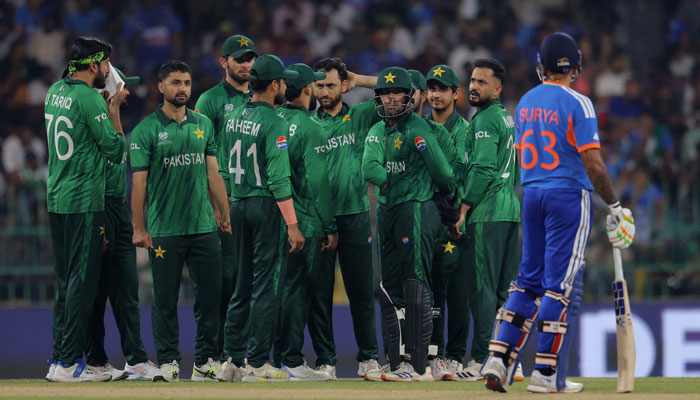
In the ICC T20 World Cup, India defeated Pakistan by 61 runs in a crucial group-stage match and secured their place in the Super Eight round. The high-pressure contest between the two rivals once again grabbed global attention, as India dominated with both bat and ball in this India beat Pakistan by 61 runs encounter. The match was played in front of a packed crowd and proved to be one-sided after Pakistan failed to chase the target.
The match was played at the R. Premadasa Stadium in Colombo, where Pakistan captain Salman Ali Agha won the toss and chose to bowl first. Notably, the captains of both teams did not shake hands at the toss. Batting first, India scored 175 runs for the loss of seven wickets in their 20 overs.
Indian opener Abhishek Sharma was dismissed for a duck in the first over by Salman Ali Agha. However, Ishan Kishan played a brilliant innings of 77 runs off 40 balls before being bowled by Saim Ayub. Tilak Varma scored 25 runs, while Hardik Pandya was dismissed without scoring. Indian captain Suryakumar Yadav added 32 runs, and Shivam Dube contributed 27. For Pakistan, Saim Ayub took three wickets, while Usman Tariq, Shaheen Afridi, and Salman Ali Agha picked up one wicket each.
Also Read: Snake Spotted at Stadium Ahead of Pakistan-India Clash in T20 World Cup 2026
Chasing a target of 176 runs, Pakistan struggled under pressure and were bowled out for 114 runs in 18 overs. Usman Khan was the top scorer with 44 runs, while Shadab Khan scored 14 and Faheem Ashraf added 10 runs. India’s bowling attack was strong, with Hardik Pandya, Varun Chakravarthy, Jasprit Bumrah, and Axar Patel taking two wickets each. Tilak Varma and Kuldeep Yadav claimed one wicket each.
Pakistan kept the same playing XI for this match, including Babar Azam, Shaheen Afridi, Shadab Khan, and others. India made two changes, bringing in Abhishek Sharma and Kuldeep Yadav. Overall, it was a commanding performance as India beat Pakistan by 61 runs, strengthening their position in the ICC T20 World Cup and confirming their qualification for the next stage.